
According to a recent post on the Washington Post, the upcoming season of Top Chef will be filmed in Washington, D.C. The show is set to begin taping in the spring.

But, we were finally going to The French Laundry. We had driven past it several times on the way to eat at one of Yountville’s other spectacular restaurants, but had never crossed its threshold. We had even seen Chef Keller walking around town a couple of times. And, most recently, after being awake for almost 20 hours straight, we had slept through a reservation on the day we got engaged. Now, there was nothing between us and dining at what the New York Times had once called the most exciting restaurant in America but about 100 yards and finding exactly where the front door was located.
Superlative words have been written about The French Laundry almost since the day that Thomas Keller took over its kitchen in 1994. I’m sure that I can’t add anything to this long list of laudatory reviews. Let’s just take it as given that the food was fantastic, the service was precise and professional, and the experience was exceptional.
Nevertheless there were still “wow” moments in the eighteen courses (nine each) we enjoyed over the three and a half hours we were at the restaurant. Although these are certainly worthy of mention, it was the overall experience of dining at the restaurant from the moment we entered the courtyard outside of the front door to hearing the door close behind us that has stuck with me. With the exception of trying to figure out how to use the foie gras accoutrements – triangular pillows of toasted brioche and three types of coarse grained salt – it was a comfortable and relaxed experience uncommon in such fine-dining atmospheres.
Enough chatter. What about the food?
The meal got off to a perfect start with two of the Laundry’s signature dishes: salmon cornets and “Oysters and Pearls.” For my vegetarian partner, the salmon cornet was modified into an artichoke “tartare” cornet. The artichoke was so finely chopped that it looked like shaved ice.
These two dishes are perfect examples of Keller’s approach in the kitchen: witty, evocative, and precise. The inspiration for the salmon cornets, which look like little ice cream cones with a scoop of glistening pink sorbet, was, allegedly, a late-night visit to an ice cream shop. With this dish the wit is clear, the dish is visually evocative of something familiar and fun, and the flavors are harmonious. “Oysters and Pearls” are playful more in name than in visual presentation. Resting on a bed of tapioca pearls, two briney and delicate oysters arrive with a generous dollop of salty, savory caviar.
These were the two dishes I knew I would eat – they never leave the menu – but, somehow, they still managed to surprise me because of how bloody good they were. They were my two favorite dishes of the meal.
In his four-star review of Keller’s New York City flagship restaurant Per Se, New York Times critic Frank Bruni said that the meal that solidified the fourth star was the vegetarian tasting menu. Both Per Se and The French Laundry have two nine-course offerings per night: the Chef’s Tasting Menu and a “Tasting of Vegetables.”

(The French Laundry Garden, directly across the street from the restaurant.)
My fiancée ordered the Tasting of Vegetables and two of the courses were vegetables she doesn’t like: eggplant and mushrooms. But, as an example of the kitchen’s skill, these ended up being two of her favorite dishes. The eggplant was a particular standout. Cooked sous-vide, the Japanese eggplant had a fleshy look and texture. Paired with Madras curry, cauliflower, and chickpeas the dish was a standout and a surprising taste of India in the beginning of the meal.
Having checked the daily menu religiously for the month leading up to our reservation, I had noticed that a roasted hen-of-the-woods mushroom dish had become popular on the menu. Given my fiancee’s aversion to mushrooms, I was worried that she might not like it. I should have had more confidence in The French Laundry kitchen. Like the eggplant, it was a standout dish that had a wonderful, rich earthy flavor that was perfect for a winter’s night.
There were two low points early in our meals and for similar reasons. (“Low,” of course, is entirely relative in the context of this otherwise amazing meal.) For me, it was my tuna tartare dish (three of nine?), and for my fiancée it was her beet salad (course two of nine). Both were minimal to the point of barely being noticeable in caloric intake and it seemed like the kitchen spent more time on visual appeal than on flavor composition.
Keller is a fan of the “composed” cheese course. In other words, a cheese course that looks like a real dish with cheese as the star, rather than simply a hunk of cheese with some bread, marmalade, and nuts. This approach is fantastic because it pairs untraditional accoutrements with a certain cheese. My cheese course – “Manchester” – (the menu’s excessive use of quotation marks remains a mystery), for example, played off the now omnipresent beet and goat cheese pairing, but with some added highlights. Most notably, the addition of light, fresh brussels sprouts leaves – just the leaves – was a perfect counterpoint to the richness and earthiness of this combination.What was on the plate did taste good, but I realized a new pet peeve. I don’t like it when chefs force you to compose your own bite. Take my tuna tartare as an example. The hearts of palm, perfect pink cubes of bluefin tuna, and ginger were scattered around the flat white plate like individual Lego blocks on the floor waiting to be put together. Considering the diversity and sparse amount of ingredients, I wasn’t sure how to compose a bite of food. Each individual ingredient was, of course, delicious, but it was near impossible to get a sense of how they were intended to fit together.
We could tell that the meal was starting to wind down as soon as our cheese course arrived. It is difficult to break up with someone after building up a relationship over six unforgettable courses, but the final three courses let us down easy.
A few minutes after our empty cheese plates were whisked away, the sorbet course arrived. Sorbet is rarely elevated to sensational heights. The course, after all, is mainly a functional one. And, although both of our dishes were delicious, what was most impressive about them was that the same high standards were clearly applied to this course as the butter-poached lobster tail. Flavored frozen water was given the same respect as a pricey, luxurious piece of seafood.
Finally, dessert. Our two desserts were an “Opera Cake” and a Peanut Butter “Bavarois.” (I told you about those quotation marks.) A traditional opera cake is France’s answer to tiramisu, but without the hacking-cough-inducing cocoa powder. The Laundry’s version didn’t use sponge cake, but did have a thin layer of chocolate ganache formed into a tube filled with a praline cream like a cannoli. The most intriguing element of the dessert, however, was a milk granité.
But, the Peanut Butter “Bavarois” was our favorite of the two. It was a rich a peanut butter Bavarian cream with milk chocolate “whip” on a light, crispy crust (a “feuilletine”). This was paired with a banana sorbet that perfectly captured the flavor of the fruit and had an amazingly smooth texture. It’s not that there was anything wrong with the Opera Cake to make us like it less, it’s just that the peanut butter and chocolate combination is always a winner. And, when prepared by The French Laundry it is even that much better.
In addition to a menu that can make one’s mouth water, The French Laundry also has an encyclopedic wine list that would pique even an experienced wine collector’s curiosity. It is also really, really expensive. The Laundry has, by far, the highest wine mark-ups in the Valley. One reason for this is that service is included in the price of the bottle. However, taking my housemate’s recommendation we decided on a strategy to avoid the high prices.
We planned to suck it up and pay the $50 corkage fee for our bottle of red, order a half bottle of white for the early courses, and have a glass of sparkling as an apertif. It ended up working perfectly. Like many restaurants that serve long, multi-course dinners, the Laundry has a great selection of half-bottles, which allows diners to try a number of different wines as the meal progresses. We selected a half-bottle of chardonnay from Burgundy, France. In particular, we selected a bottle from the Meursault area, which traditionally make some of the richest chardonnays in Burgundy. It paired well with many of the decadent flavors and ingredients in the meal, such as my foie gras and my fiancee’s turnip soup.

Keller’s goal for each dish is to serve just enough food that the diner wants one more bite of food at the end of the course. After nine courses, this adds up to enough food to be almost perfectly sated without being stuffed. As we were walking out the door, I found myself wanting one more bite of food, one more sip of wine, and just to stay a little longer.
I did not know this before I started making wings this past NFL season, but the “original” Buffalo Wing Sauce recipe is simply a 50-50 mixture of melted butter and Frank’s Red Hot Sauce. Since I am not a very big fan of butter, I decided to try a 67-33 mixture of my homemade hot sauce and butter.
However, I was watching this Super Bowl in the Napa Valley and simply adding melted butter to hot sauce didn’t seem like much of a culinary challenge. Instead, I decided to make a slightly different version of the beurre blanc sauce from my earlier salmon and leek recipe.
I followed the same basic instructions from the Bouchon Cookbook, but with two alterations. First, I added some finely chopped garlic to the shallot-wine-vinegar base, because my favorite wing sauces typically have a nice garlicky flavor. Second, I did not add cream to the reduction before melting butter into the sauce. I wanted to stay as “traditional” as possible and retain the original hot sauce-butter recipe.
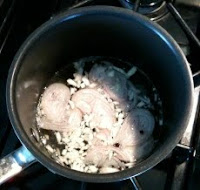
(Beurre blanc base with lots of chopped garlic)

("Butter, butter! Give me butter! Always butter!" - F. Point)

(Fresh beurre blanc!)
With the two key elements of the sauce completed, I turned my attention to the chicken. Since I had good luck with Petaluma Poultry’s roasting chicken back in my very first recipe, I bought two packs of “Rocky Jr.” wings at Whole Foods.

In order to add just a little bit more flavor to the wings, I quickly brined the wings in a very basic salt, honey, and thyme brine. They only sat in the brine for about an hour, because wings, obviously, are much smaller than an entire chicken (about 6 hours of brining). I dried the wings before setting them out to be cooked.

Although most wings are fried, I prefer to bake my wings. Considering I’m bathing them in butter, I figure that I don’t need to add any more plaque to my arteries. Before putting them in a 375-degree oven I put a little salt and pepper on the wings for a final dose of flavor. I took them out after about 45 minutes.
Now, it was time to put all the elements together. I had taken the hot sauce out to come to room temperature and measured out 2/3 of a cup of sauce and 1/3 of a cup of beurre blanc. I combined them in a measuring cup, stirred, and poured them over the wings, which were resting in a mixing bowl.

(1/3 of a cup beurre blanc; 2/3 of a cup hot sauce)
Sitting back with a plate full of wings and a Bear Republic Racer 5 IPA in the first quarter as the Colts looked ready to roll over the Saints, I was very content. The spice from the hot sauce and the tangy richness of the beurre blanc worked well together to create a distinctive sauce. The hot sauce, however, was a bit of a one-note sauce. It satisfied its requirement of being hot, but didn’t have much depth to it. This might have been due to the short aging period or the types of chiles I used. Needless to say, it will be a fun challenge to find new ways to improve on Batch #00 of my homemade hot sauce.


I enjoy duck in many forms, from the legendary Peking Duck at the Peking Gourmet Inn in Falls Church, Virginia to a tasty Duck Confit. I decided to start off simple: roast duck. Plus, the process would give me a necessary by-product if I wanted to try the more complicated confit method: duck fat.
I did not have a good roasting weekend. Both the duck and the next roasting recipe I tried ended up slightly overcooked. The duck stayed in the oven for about 15 minutes too long. Luckily, my overcooking couldn’t completely destroy the great natural flavors in this fresh, local duck from nearby Sonoma Poultry.

(When you buy a duck...you get a whole duck.)
The most difficult part of the process was deciding which recipe to follow. I found a number of different recipes each with different cooking times (from 90 minutes to four hours) and different methods for dealing with the thick layer of fat under the duck’s skin. Here is a sampling of approaches from three well known cooking authorities:
James Beard: cook at 350 degrees for 2.5 hours, pierce skin all over and turn heat up to 400 to cook for 15 minutes and allow fat to drain from skin
Julia Child: cook at 350 degrees for about 90 minutes (she notes that the French like their duck medium-rare) or a little longer for medium, pierce skin before roasting to allow fat to drain during roasting
Ina Garten: pierce duck skin and place duck in a simmering pot of chicken stock for 45 minutes; skim off duck fat that rises to top; allow duck to dry, then roast in 500 degree oven for 30 minutes
I decided to strike something of a middle ground and combine Beard’s and Julia’s approaches. I pierced the skin, making sure not to go all the way through to the flesh, before roasting (Julia’s approach), but decided to leave it in for about two hours (Beard’s approach).

(Duck, trussed and ready to roast)
One of the reasons why roasting a duck appears so daunting is the task of managing the fat. Approximately every twenty minutes, I poked holes in the duck skin on the breast, leg, and thigh with the point of a knife to release additional fat from under the skin. After the duck cooked for a little while it was easy to understand why Beard suggested waiting a little while to pierce the skin: it’s much easier to do once the skin gets slightly crispy. I’m also curious what, if any, affect leaving the fat under the skin has on the flavor and moisture of the meat. But, that’s for another attempt.

(After roasting...you can see the marks in the crispy skin to release the subcutaneous layer of fat)
By the end of the roasting period, the bottom of the pan had collected a large amount of grease, which I saved (but sadly never used). The skin had turned a dark shade of brown and was very crispy. After taking it out of the oven, I let it rest for about 10 minutes.
Carving the duck was a little more complicated than carving a chicken, because there is less meat and more bone. Also, the bones aren’t where you expect them to be. For example, the joint that connects the thigh to the body is much further underneath the duck than on a chicken. It took about four minutes of frustrating searching with the tip of my knife before I finally just ripped it off.
The thigh was tender, but the leg meat and skin had dried out a little too much. Luckily, the meat retained the traditional duck flavors that are a mix of sweetness and gaminess. Similarly, the breast meat was a mix of moist and dry meat but still flavorful.

I served the duck with an improvised foccacia dressing (I didn't want to stuff the bird on my first attempt) that I baked in the oven. I took about half of a plain foccacia loaf that I purchased from the Model Bakery, chopped it into approximately one-inch cubes, and sauteed them with some shallots in a little butter until the bread got slightly browned. I put the bread crumbs in a square, glass baking dish with a few tablespoons of chicken stock to add some flavor and moisture. I put it in a 350 degree oven for about 20 minutes or so. It probably could have gone a little longer, but since I wasn't following any recipe and the duck was ready I pulled it out.
It was my time ever cooking a “game” meat and I’m glad that I tried it, even if it wasn’t a total success. But, I learned some valuable lessons for my next attempt and ended up with some good leftovers that turned into a tasty second meal.

Thomas Keller’s third restaurant in Yountville (fourth, if you count Bouchon Bakery) serves a single four course prix-fixe menu that changes every day. In other words, if you don’t like what they’re serving that night, pick a different restaurant. Each day’s menu is posted on the website by 11 a.m. PST and includes an appetizer (usually a salad or soup), a main course, a cheese course, and dessert. The four courses, each of which is served family style, will run you $49. If you choose to sit at the bar, however, you can order the courses a la carte, but you’re still limited to the same four items.
I’ve eaten at Ad Hoc twice in the past week, once with a friend and once on my own at the bar. Both experiences were phenomenal. But, I suppose I shouldn’t have expected anything different from one of Thomas Keller’s restaurants.
Consistent with my experiences at other Keller outposts, the staff was knowledgeable, courteous, and professional. The interior was tasteful, clean, and appropriate for the atmosphere and type of food being served. In this, Keller’s most casual restaurant, the wines by the glass are served in tumblers and classic rock hits play in the background. The casual American theme even extends to attire. Rather than the tuxedo shirts and bowties worn by Bouchon’s staff down the street, Ad Hoc’s waiters sport relaxed dark brown bowling shirts.
I enjoyed all eight of the courses that came out of the Ad Hoc kitchen, but a few stood tall over the rest.
One of those was my first spoonful of food at Ad Hoc, the chicken and dumpling soup. I had seen this recipe in the Ad Hoc at Home cookbook and it looked amazing. It looked even better in person. One thing that I did not expect is that each course is served family style. The soup was delivered in a large bowl with a ladle set in the middle of the table, leaving my friend and I to fight over the luxurious chicken broth (those words don’t normally go together, but it aptly describes this soup – it’s better than your grandmother’s, I promise) and the last of the soft, pillowy herbed dumplings.

The soup was followed by a grilled lamb sirloin with braised mustard greens, acorn squash, and hush puppies made of black garbanzo beans and sweet potato. I grew up, like many Americans, with roasted lamb served by a food that looked about as naturally green as Mint Chocolate Chip Ice Cream: mint jelly. Needless to say, I never developed much of an affection for lamb. Ad Hoc’s grilled lamb, however, needed no green jelly. A cheese course with a sour bergamot jelly, which tastes kind of like sour orange rind, followed. This was the evening’s least successful course. The cheese didn’t have much flavor and had an unappealing rubbery texture. The highlight was the fact that both my friend and I remarked that the breadsticks tasted like Pepperidge Farm Goldfish.

The bergamot jelly made another appearance when I ate at the bar a couple nights later and was a fantastic pairing with the Mona, a sheep and cow’s milk cheese from the Wisconsin Sheep Dairy Cooperative. (I’m not ashamed to admit that I was a little gauche and took the leftovers of my cheese course to go. I mean it’s not like they’re going to serve it to someone else, right?) These two elements of the cheese course were balanced by some wonderful honey that had a naturally smooth vanilla flavor.
Dessert on both nights provided a fitting and satisfying conclusion to the meal. In a meal anchored by chicken soup and roasted lamb, the rich and dense sticky toffee pudding rounded out a satisfying winter supper. A few nights later, the lemon pound cake with huckleberry sauce and crème fraiche was rich, yet citrusy. The familiar deliciousness of lemon pound cake was almost overshadowed by what in any other restaurateur’s hands would have been a throwaway garnish. Candied pine nuts. It is often these singular, unanticipated little bites of pleasure that I’m finding to be a hallmark of the dishes in Keller’s restaurants. They often transform the familiar into the unexpected and exceptional.
The cheese and pound cake would have been the highlight of my second meal if it hadn’t been for the fried chicken. It is so popular at Ad Hoc that not only have they packaged the mix for the chicken for sale at Williams-Sonoma stores, but it is also the only entrée in regular rotation (every other Monday night). Having heard rumors of its popularity, I arrived early to ensure grabbing a seat at the bar. It was a good thing I did, because by 6 p.m. there was only one stool open. Later in the night, a local who regularly visited Ad Hoc (I think the entire waitstaff knew her by name) told me that during the summer people have been known to wait for a bar stool on fried chicken nights for up to two hours. Not waiting two hours: yet another benefit of traveling to wine country in the off-season.

I don’t think the kitchen is accustomed to serving solo diners, because I received a generous serving of five pieces of perfectly fried chicken. I love fried chicken. I had been looking forward to this dinner all day. I had a small lunch and even went for a run in the afternoon. I walked in the door to Ad Hoc hungry and ready for business. I’m not ashamed to admit that I ate all five pieces of my chicken. I was, however, a little embarrassed when I realized that the woman next to me, also dining alone, only ate two of her five pieces.
So, what made this the best friend chicken ever? First of all, it wasn’t greasy. Even the parchment paper at the bottom of the All-Clad bowl in which the chicken was delivered only had minimal grease stains. Second, the skin was perfectly crispy. Although it is fried to a slightly darker color than we might be used to in fast-food chains, neither the skin nor the meat was overcooked. Third, and most importantly, flavor. There was flavor in both the meat and the breading. The meat’s flavor and moisture is due, most likely, to brining. In case you missed it, the chicken was amazing. I’ve spent the time since this dinner trying to determine whether it’s worth it to travel back to Yountville from D.C. one Monday a month. The jury’s still out.
Lest I forget that I’m in wine country, Ad Hoc also has a well-rounded and reasonably priced wine list. In fact I spotted a couple wines from the Bouchon wine list on the Ad Hoc list, but at about a 25% discount. This is just another indication that this restaurant is catering to a crowd whose plastic doesn’t come in gold, platinum, or black.

Similar to the restaurant’s approach to food, it also has nightly wine specials designed to pair well with the evening’s meal. For example, on the first night there was an option to get a pre-selected wine pairing for each course. On fried chicken night, however, there was a sparkling wine being poured by the glass that is normally not on the list. But, for those diners who are tired of drinking wine, the staff is happy to suggest beer pairings too. To accompany my fried chicken, I selected “Blue Apron Ale,” which is a proprietary brown ale made just for Keller’s restaurants by Brooklyn Brewery in New York.
While I’m not ready to put Ad Hoc ahead of Bouchon on my list of favorite Napa restaurants, it does satisfy that craving for good, soul-satisfying, American food prepared at a high level. Also, don’t forget to check out the Ad Hoc at Home cookbook, which is my favorite of Keller’s four.


 Posts
All Comments
Posts
All Comments


